
















SERVICES: Consulting Activities
Optimization: People, Processes, Systems
Scope
EquoVis subscribes to the principle that data quality is at the root of business intelligence value creation, which in turn depends upon aligning the interests of stakeholders involved at data entry with those processing the information downstream. The EAM value chain diagram below illustrates the key process components and the associated information flow - sequence, feedback, and dependencies.
Of note, data entry by the end-user (step 3), which represents the source of virtually all new information in the data value chain, is the focal activity about which all other process steps revolve. As such, all people-process-system settings must be aligned with respect to the particular needs of this crucial function. Given the upstream feedback loops and downstream direct dependencies, any shortcoming at this pivotal juncture compromises the entire EAM data value chain.
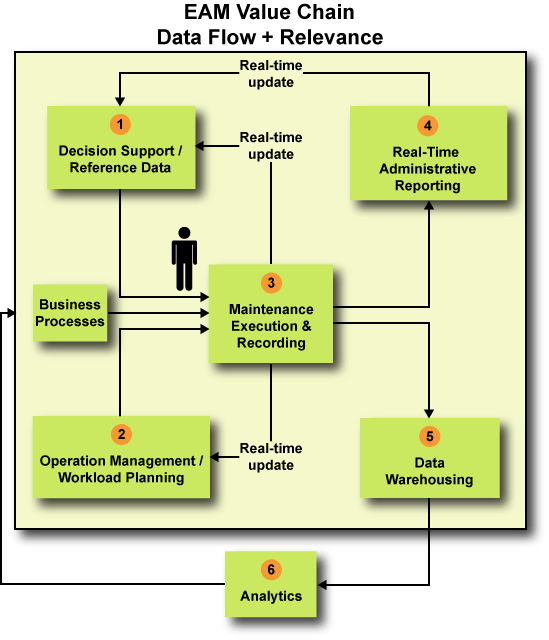
| 1. | Decision Support / Reference Data: provides contextual information of the given target asset’s attributes, servicing history, and current condition |
| 2. | Operations Management / Workload Planning: information system function providing cross-modular ERP integration and intuitive layout for the aggregation, planning, and processing of the workload associated with the multiple assets under the end-user’s responsibility |
| 3. | Maintenance Execution & Recording: user-machine system interface for the real-time entry of asset servicing and administrative data, incorporating coding automation, audit, and edit capabilities |
| 4. | Real-Time Administrative Reporting: data automatically processed and posted to downstream enterprise accounting and operations control reporting info structures |
| 5. | Data Warehousing: periodic staging and compilation (not necessarily real-time) of EAM data into repositories used by the analytics function |
| 6. | Analytics: broad range of data mining, research, and modeling activity used to direct people-process-system value chain improvement efforts |
Services
EVI's approach addresses the classic ERP user-interface shortcomings — cumbersome, unintuitive navigation; multi-layered, rigid screen layouts; etc. — by promoting data accuracy, consistency, and timeliness. This is accomplished by focusing on end-users' needs, providing them direct benefits via the incorporation of fundamental application features, such as:
- Automated, assisted data entry (e.g. intuitive data processing screen flows; mechanized default input, where applicable; custom, tailored search capability; etc.)
- Incorporation of on-line business-centric data entry audits / edits that identify inconsistencies or errors as they occur, thus assuring information quality, reinforcing user training and education, and precluding the need for effort intensive error chasing and after-the-fact corrections
- Integrated (bolt-in) ERP enhancements and functional extensions, to promote and extend the inherent performance and TCO benefits of a central systems platform
Process: review the current process flow as designed and executed (from an enterprise perspective); analyze and identify any systematic or isolated shortcomings; revise, re-engineer and implement as necessary
System: develop, implement, and support complimentary system functionality that leverage ERP basic strengths, by facilitating usability (automated coding, on-line data entry audit and edit, etc.) and extending the functional scope (data structure, package, report enhancements; mobile reporting; cross-application processing and integration, etc.)